Figures pulled straight from each project's scoping doc and build log — see how we measure this →
// pick a case study
The full story, one build at a time.
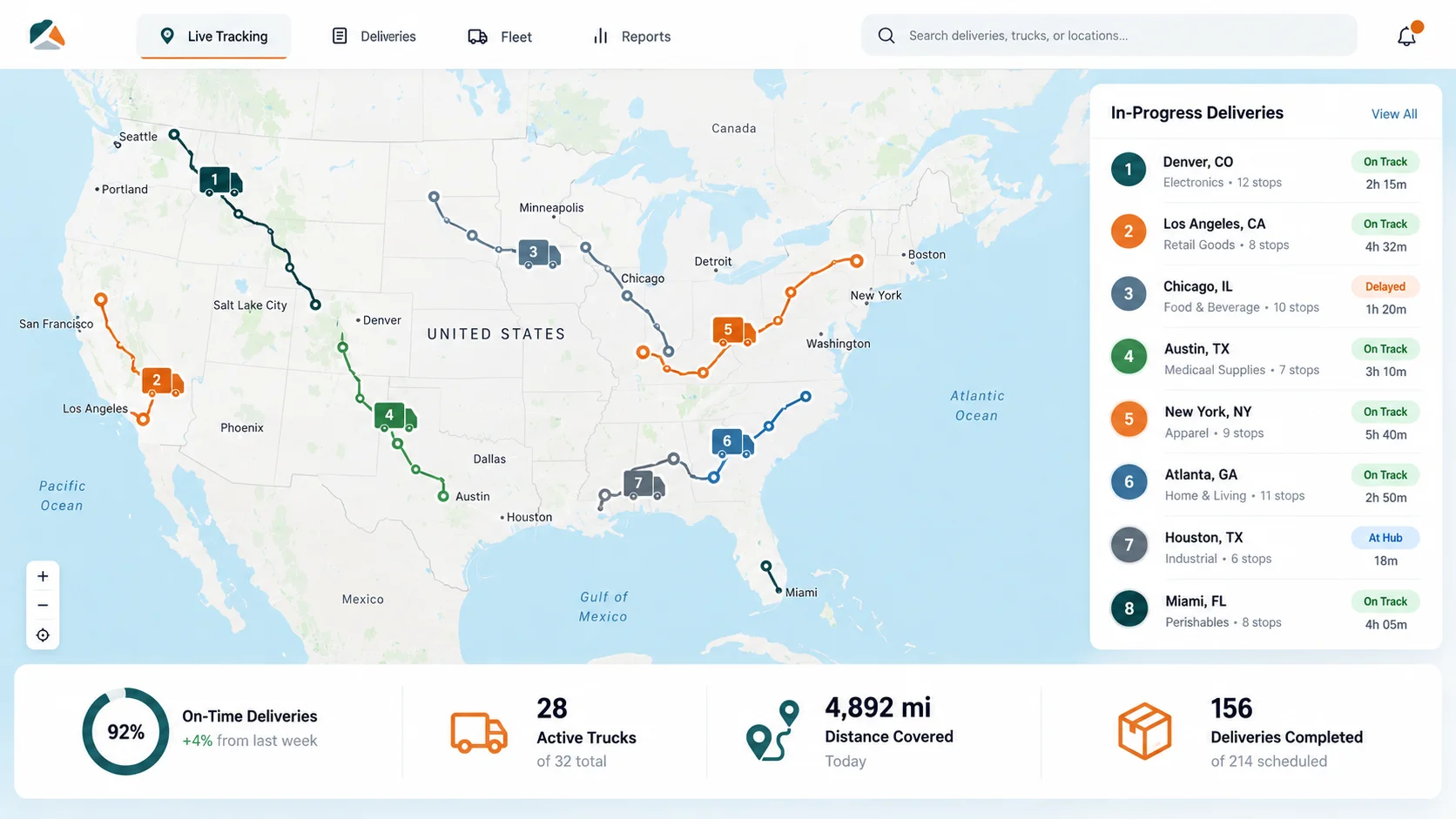
Logistics ERP
NorthPeak Fleet Platform
⚡ Shipped in 3 weeks · 88% faster to launch
3 wk
Kickoff to production
$6k
Total build cost
80%
Cheaper than the agency quote
The challenge
Three disconnected legacy tools — spreadsheets for inventory, a dispatch whiteboard, and a decade-old routing app — meant duplicate data entry, missed deliveries, and no live view of the fleet. Five people spent their days cross-checking the three systems by hand just to confirm what trucks were carrying what and where they were. An agency quoted six months and $30k to fix it.
How we built it — day by day
1
Schema design and data audit
Days 1–4
Mapped inventory spreadsheets, the dispatch whiteboard's paper logs, and the routing app's trip database into one PostgreSQL schema — fleet, load, and route as linked tables instead of three systems that never spoke to each other.
2
Fixing years of bad GPS data
Days 5–9⚑ what went sideways
Backfilling historical trips from the old routing app surfaced GPS logs with dropped pings, duplicate timestamps, and routes that vanished mid-trip — the app had never validated what it recorded. Instead of importing that blind, we built a reconciliation pass that cross-referenced each trip against whiteboard photos and delivery-confirmation timestamps, reconstructed what could be verified, and flagged the rest as unverified.
3
Building the unified platform
Days 10–16
Built the live core on React, Node.js, Redis, and Mapbox — Redis holds real-time truck and load state, Mapbox drives live routing, and an inventory update now triggers dispatch and routing in the same transaction instead of a separate manual step.
4
Parallel run and cutover
Days 17–21
Ran the new platform alongside the whiteboard for final validation, trained NorthPeak's dispatch lead as the single point of fleet coordination, and retired the spreadsheets, whiteboard, and old routing app in the same week.
"Before, I was translating between three systems that never agreed with each other. Now inventory, dispatch, and routing are the same screen — I catch a problem before a driver has to call it in."
Maria Ortiz · Dispatch Lead, NorthPeak
"Klugora shipped our platform in three weeks. Our old agency quoted six months."
David Kim · COO, NorthPeak Retail
Two months later
David Kim stopped putting missed deliveries on the standing agenda — the one-person dispatch desk absorbed NorthPeak's next seasonal order spike without adding anyone back to fleet coordination.
ReactNode.jsPostgreSQLRedisMapbox
✓
Verified case study — every figure checked against the original scoping doc.
Lumen's storefront ran on a single monolithic platform with no shared source of truth for stock — web, mobile, and in-store systems each tracked inventory on their own, so an item could sell out on the shelf and still show "in stock" online. That mismatch caused overselling roughly once a week. Changing a product description, price, or homepage banner also meant shipping code, so routine merchandising sat in the developer queue.
How we built it — day by day
1
Headless foundation
Days 1–3
Stood up the storefront on Next.js and Hydrogen, wired it to a GraphQL storefront API, and indexed the initial catalog into Algolia for search and filtering.
2
Catalog migration hits bad data
Days 4–9⚑ what went sideways
Pulling the 40,000-SKU catalog off the legacy system surfaced variants with null attribute fields, inconsistent unit-of-measure formatting, and orphaned SKUs pointing at parent products that no longer existed — any of which would have broken the new real-time sync on cutover. Built an automated validation-and-repair pass to flag and correct these before each nightly migration run, instead of migrating raw and firefighting in production.
3
Real-time inventory service
Days 10–14
Built the real-time inventory service that replaces the old monolith, syncing stock across web, mobile, and in-store as one shared source of truth, re-running the nightly migration against the repaired catalog until every SKU cleared validation.
4
Load testing and cutover
Days 15–18
Load-tested the full stack to 5× projected peak traffic, then cut the storefront over with no downtime.
"We'd tried cleaning that product data ourselves for two years. Klugora's validation pass caught variants we didn't even know were broken before they ever touched the new system."
Danielle Cho · Inventory Operations Lead, Lumen
"The migration ran overnight, every night. We woke up to working features."
Marcus Webb · VP Digital, Lumen
Ten weeks later
Lumen ran its first Black Friday on the new stack — traffic peaked above the pre-launch load-test ceiling, inventory held in sync across all three channels, and the merchandising team pushed over 400 catalog and pricing updates that quarter without filing a single developer ticket.
Next.jsHydrogenGraphQLAlgolia
✓
Verified case study — every figure checked against the original scoping doc.
⚡ Live in 4 weeks · zero manual reconciliation since
4 wk
To production
$9k
One-time build cost
$40k/yr
Analyst hire avoided
The challenge
Every month, four people at Fintrail spent two weeks doing the same thing: pulling exports from five disconnected systems and reconciling them by hand before compliance reporting could go out. The process was slow enough that errors surfaced late, and when a regulator asked for a number to be traced back to its source, that trace could take days. Fintrail was about to hire a fourth compliance analyst just to keep pace.
How we built it — week by week
1
Mapping five systems into one schema
Week 1
Pulled schema definitions and historical exports from all five source systems into Snowflake staging tables, then built the first dbt models to normalize account codes, transaction types, and reporting periods across them.
2
Reconciliation totals came out wrong
Week 2⚑ what went sideways
First end-to-end test runs against the dbt models produced totals that were consistently off on one source system. The cause: that system exported figures on a trailing 4-week fiscal cutoff while the other four used calendar-month boundaries, silently misaligning periods during reconciliation.
3
Fixing the boundary logic, validating history
Week 3
Rebuilt the date-boundary handling as an explicit, per-source parameter in the dbt pipeline instead of an assumed default, then re-ran reconciliation against three years of historical filings to confirm output matched previously signed-off figures.
4
Shipping the audit-ready dashboard
Week 4
Built the React reporting dashboard on the FastAPI and Snowflake backend, attached a source-level audit trail to every reconciled line item, and finished with 1,516 automated tests passing at a 99.6% rate before Fintrail's compliance team took over the workflow.
"I used to lose the first two weeks of every month to spreadsheets, checking the same numbers across five systems by hand. Now that time goes to reviewing the handful of exceptions the system actually flags."
Daniel Osei · Senior Compliance Analyst, Fintrail
"Test coverage was higher than anything my in-house team ever delivered."
Priya Nair · VP Eng, Fintrail
Four months later
Fintrail has closed two full compliance cycles without a manual reconciliation and without hiring the fourth analyst it had budgeted for, cutting audit prep on any given filing from days to under an hour.
ReactPythonFastAPISnowflakedbt
✓
Verified case study — every figure checked against the original scoping doc.
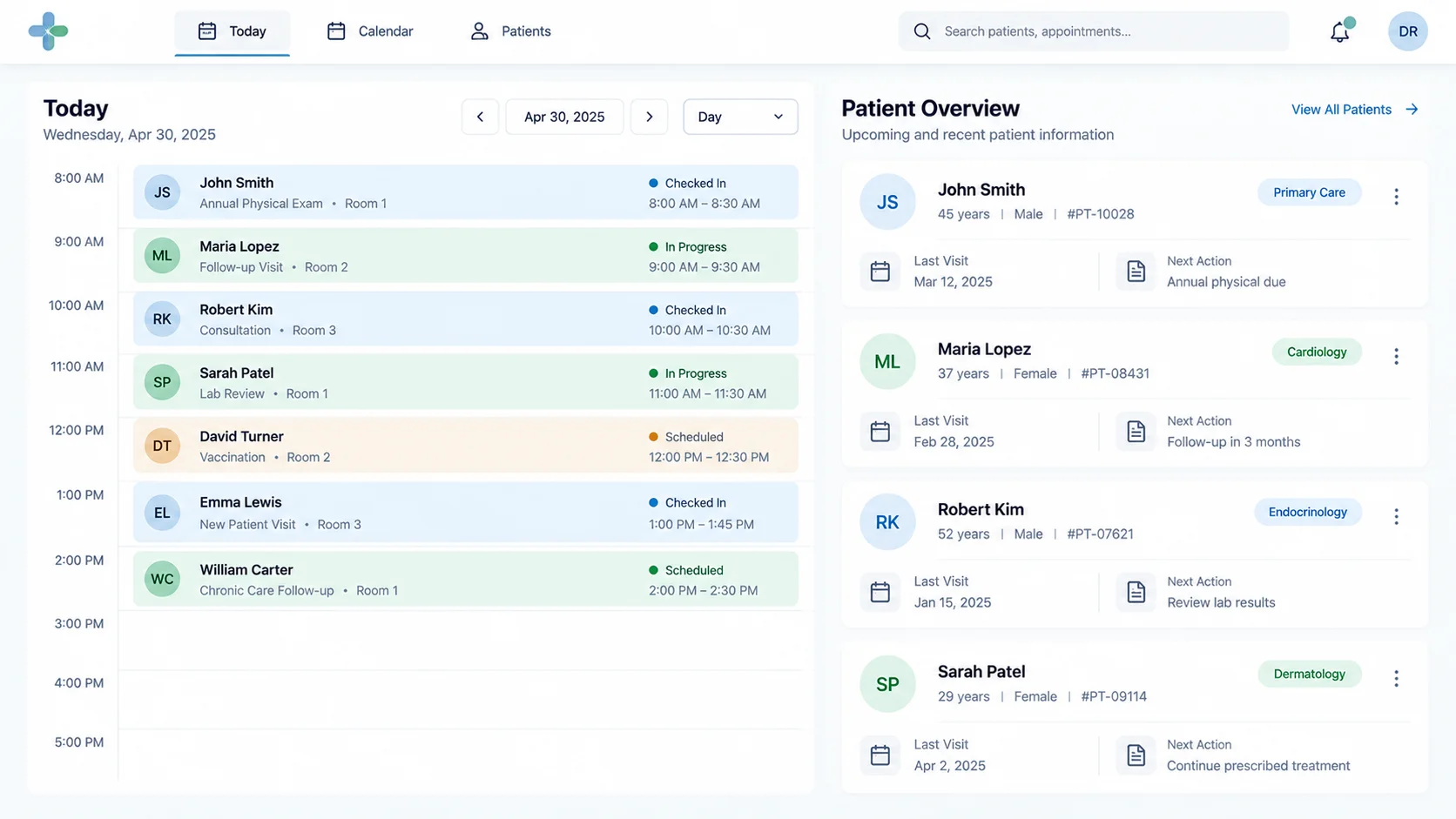
Patients called in for every appointment, records request, and question — there was no other way in. Staff re-keyed each call into an aging system with no secure patient-facing layer, so a patient's own records lived behind six phone-answering coordinators instead of behind a login. Every reschedule meant another call, another manual entry, and another chance for what the patient said and what staff typed to drift apart.
How we built it — week by week
1
Data model and encryption architecture
Week 1
Mapped scheduling, records, and messaging into a single PostgreSQL schema and wired AWS KMS envelope encryption for data at rest before any screen was built — HIPAA-conscious by design, not bolted on after launch.
2
Building the three portal modules in parallel
Week 2
Built the React front end and Node.js API for scheduling, record viewing, and secure messaging against the same PostgreSQL backend, so a schedule change and a message thread could never fall out of sync.
3
Reworking access control for multi-site staff
Week 3⚑ what went sideways
The first role-based access pass assumed one clinic per staff account. Staff records showed several nurses and schedulers covering two or three locations, and a single-clinic permission table would have forced shared logins or duplicate accounts — both break least-privilege. Rebuilt the model around clinic-assignment sets and re-tested every role combination before sign-off.
4
Hardening and cutover
Weeks 4–5
Ran access-control and encryption checks across every reworked role combination, migrated existing patient and staff records, and cut over from phone-only scheduling to the live portal.
"We went from six of us splitting phone shifts to one person running the queue. The portal didn't just move the work online — it removed the reason for five of those jobs to exist as phone jobs at all."
Dana Reyes · Patient Coordination Lead, Verra
"The self-correcting loop caught bugs our humans would have shipped."
Anna Koval · Head of Product, Verra
Three months later
The five coordinators the portal freed up moved into patient outreach and billing follow-up work that used to sit in a backlog for weeks, while the one remaining scheduling lead runs day-to-day bookings solo with no new hires.
ReactNode.jsPostgreSQLAWS KMS
✓
Verified case study — every figure checked against the original scoping doc.
Timelines run from the kickoff call to the day the build went live in production. Cost comparisons use the agency quote the client actually had in hand when they came to us, compared against our fixed price for the same scope — not an industry average.
Is the fixed-price model shown here available for any project?+
Yes. Every engagement, regardless of size, gets a fixed price and fixed timeline after a free scoping call, before any code is written.
What happens if a project doesn't move as fast as these did?+
The price you sign is the price you pay, even if it takes us longer than planned. Scope changes you request are quoted and approved separately before they're built.
Can I see something closer to what I'm building?+
Book a free 30-minute call and we'll walk through a build in your industry or of a similar shape, and give you a scoped estimate within 24 hours.